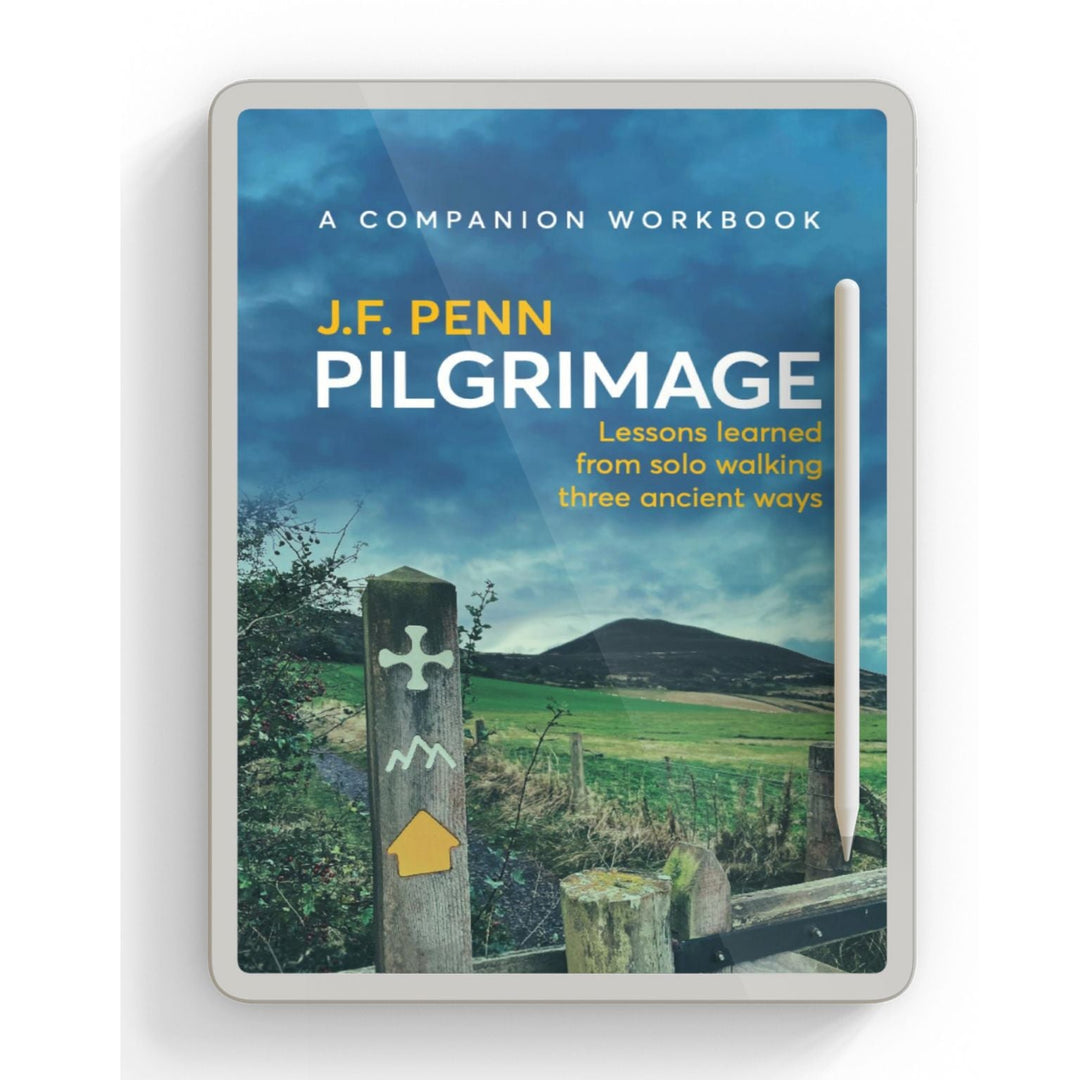


Pilgrimage: Why pilgrimage?
“Solvitur ambulando. It is solved by walking.”
—Saint Augustine
Historically, pilgrimage has been defined as a journey to a sacred place, taken for a religious reason. But perhaps it needs to be redefined for our increasingly secular age. Many of today’s pilgrims seek meaning from their journey but don’t adhere to a particular religious tradition.
Pilgrimage is a physical journey to a particular place, but it’s also an exploration of what it means to be human in a temporal body. Walking day after day breaks down the outer layers of the modern world through hardship in the elements. It reduces each day to walking, eating, sleeping — the basic acts of a human life. We are part animal, part spirit, and pilgrimage engages both sides.
It’s also a linear journey with a beginning and an end and a way to get from one to the other. Life itself is never so straight-forward and clear-cut, so pilgrimage provides structure and boundaries for periods when life feels storm-tossed.
There is always hardship, but the pilgrim determines the shape of the challenge by their choices of where to sleep, what to carry, who to go with, and how much preparation to do. The way will provide surprises and the pilgrim will have to adapt, but the resilience gained can pay huge dividends for the rest of life.
The call to pilgrimage
“In the moment of darkness, the call comes.”
—Phil Cousineau, The Art of Pilgrimage
I first heard about the Camino de Santiago in my late teens. The Pilgrimage by Paulo Coelho made its way into my hands and sparked something in my imagination that would rear up many times over the following years. Whenever life challenged me, I wrote in my journal that I would walk the Camino some day, in the hope of a transformation.
I still have all my journals and I find mention of pilgrimage sporadically over the years. When I burned out in London at the Millennium and left England for Australia. When my first husband left me and I struggled through divorce. When I hated my corporate job so much, I cried in the bathroom most days, trying to find a way to escape those golden handcuffs.
Each time, I resisted the call to pilgrimage and found solace in other travels: The desert of Western Australia and the shores of New Zealand, the ancient places of Egypt, and eventually, back to London for a new life as an author entrepreneur.
But the Camino kept calling.
It is a mythical pilgrimage, the idea of it perhaps more powerful than its reality, compounded by the romanticised books of countless writers since Coelho.
When the pandemic hit and the world locked down, my desire to walk the Camino rose once more. But by then the virus raged, and it was impossible to travel. I had taken for granted the fact that I could walk it anytime, putting off the decision for decades, and now the opportunity might be lost forever.
Since I couldn’t travel far, I researched pilgrimages in England and decided to walk the Pilgrims’ Way, a medieval route from London to Canterbury made famous by Chaucer’s The Canterbury Tales. It would be my first solo multi-day walk and my first step towards walking the full Camino.
There is never a right time to go on a pilgrimage, but if you feel the call, then heed it. You never know when it might become impossible for you.
If you’ve lost direction in life, pilgrimage can help
A pilgrimage is a specific task with a clear direction.
You have a starting point and a destination and, if you follow the way-markers, you have a route to get there.
Once you are on the trail, whichever that might be, the pilgrim’s day is much the same — pack up, walk, eat, rest, sleep. You might get lost for a short time, but if you keep going, you will reach the end.
A pilgrimage journey may be the clearest path you will ever follow in life, with only a few basic choices to make each day. That minimalism can be a great comfort in difficult times.
You have no purpose but to get up and walk, and if you make it to your destination for the night, you have achieved your goal. The daily difficulties of normal life fade away as you deal with the immediate issues of pain and hunger and exhaustion. You sleep satisfied, and tomorrow you get up and do it again.
Pilgrimage brings perspective
Walking every day shrinks life down to its basic elements. You appreciate the simple things — shelter from the rain and wind, a hot shower after a long day, painkillers and blister plasters, coffee in the morning or a cold beer when the sun is high, local bread and olive oil when you’re hungry, an encouraging smile from another pilgrim.
Once you step away from your normality and see how other people live, once you experience being uncomfortable, or in pain, somewhere you can’t control your environment, you will be grateful for what you have and what you will return to. It’s too easy to take these comforts for granted until they are lost, even temporarily.
I travel partly because it helps me see how insignificant I am on the face of the world, and walking intensifies this feeling as it is so slow. When I look at a map at the end of the day, I have only crossed a tiny part of a tiny area in a little corner of the world. I can only move at my pace, which for me is what English walkers call ‘bimbling,’ a relaxed gait, stopping regularly for photos, taking notes, or coffee when available.
When at home, the daily grind of life makes everything feel important and urgent, and I have to operate at an ever-faster pace to get everything done. It’s easy to get stressed about a deadline or the emails that pile up, or the jobs that always need doing. Perspective narrows, even as we worry about the bigger things we can’t control — the economy, war, disease.
But when on pilgrimage, I am just another human walking on the face of the world, a tiny speck in the grand scheme of things, a flash of light gone so quickly. The waves of the Atlantic will continue to crash on the shores of Portugal after my Camino footsteps have washed away. The Cathedral of Santiago de Compostela will welcome more pilgrims after I have gone. The same words of the Mass will be spoken by the next generation. I am comforted by my insignificance, and I return from pilgrimage with a new perspective on what is truly important.
“Every day I walk myself into a state of well-being and walk away from every illness; I have walked myself into my best thoughts, and I know of no thought so burdensome that one cannot walk away from it.”
—Søren Kierkegaard
Questions:
• Why are you interested in pilgrimage rather than another kind of journey?
• What might pilgrimage give you? Why do you need that?
• Do you feel called to a particular pilgrimage? Why is that?
Resources:
• The Art of Pilgrimage: The Seeker’s Guide to Making Travel Sacred — Phil Cousineau