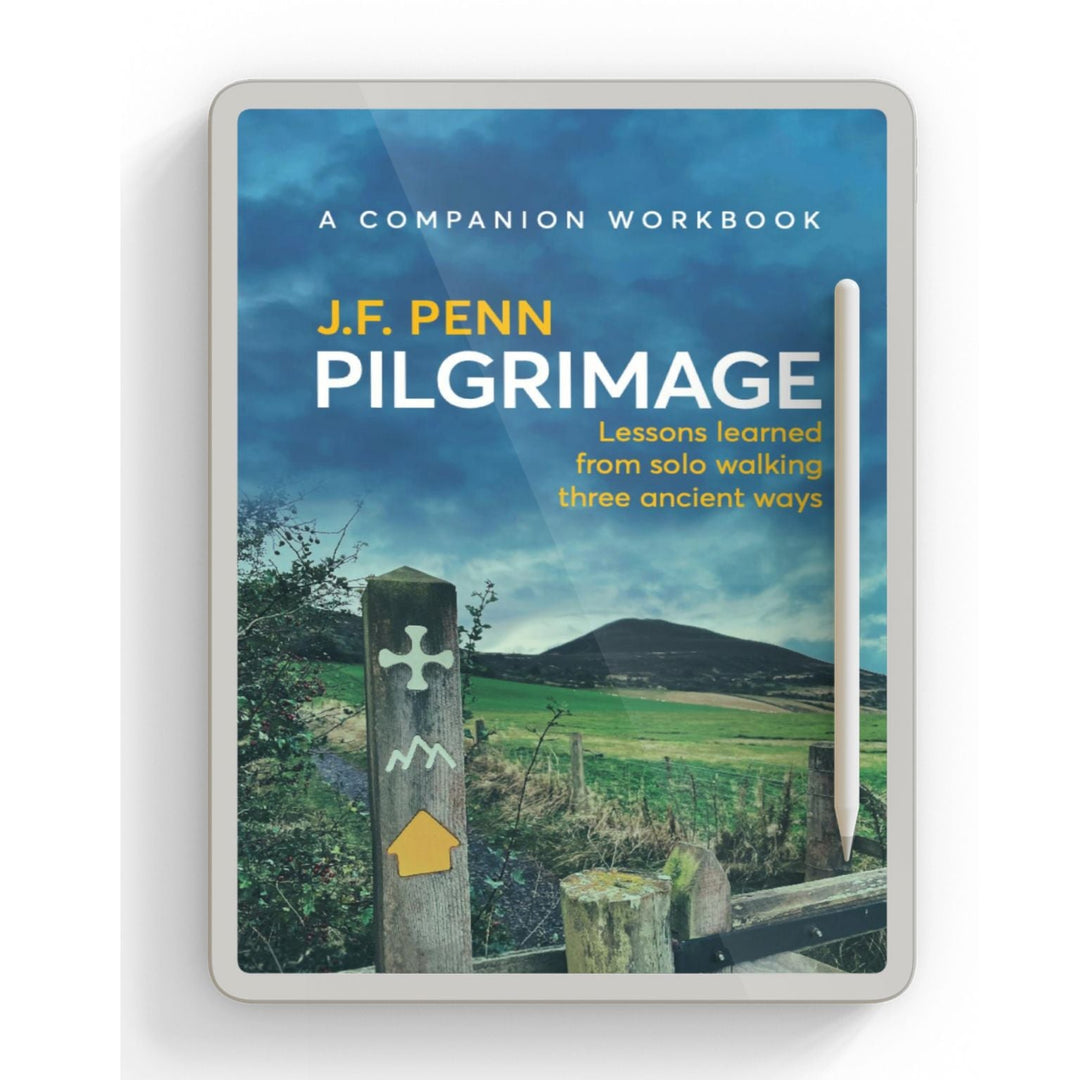


Pilgrimage: A glimpse of the divine in sacred places
“All such sites are regarded as thin places, set apart from the world, moving to a different drum, and possessed of an innately special atmosphere because of their connection to another, higher dimension.”
—Peter Stanford, Pilgrimage: Journeys of Meaning
The paths and final destinations of great pilgrimage routes have been imbued with so much meaning over centuries, they call both to those who believe and those who don’t follow a particular faith.
The depth of history and belief of the faithful over generations impart a deeper resonance to certain places where the veil is thin, and you are closer to God, or a sense of the divine. Your pilgrimage will have moments of spiritual meaning if you are open to them, although, of course, they may come at unexpected times.
Here are some moments where I glimpsed the divine while walking these ancient ways.
Crayford Ness, near Dartford, England
I was exhausted as I emerged from the Thames Path Walkway and passed through the gritty, urban sprawl of Erith in East London. I’d already walked around thirty-eight kilometres that day, and I still had several more to walk before I reached my hotel in Dartford. It was October, and dusk was fast approaching.
I took a wrong turn and found myself alongside a busy dual carriageway, the noise of so many cars jolting me back into the modern world. I considered getting a bus or even a taxi to carry me through the last few kilometres, but I had promised myself I would walk every step of my pilgrimage and this was only the first day.
As I trudged on through an industrial estate echoing with the rumble of cranes hauling heavy equipment, the screech of trucks, and the shouts of workers, I wondered what the hell I was doing there.
But then the path opened out onto a flood plain where horses grazed on common land, and the way ahead ran alongside the river once more. This was Erith Saltings, an ancient salt marsh, part of the Thames estuary that can’t be built upon as the tide may wash it away. The remains of an ancient fossilised forest dating back to Neolithic times over five thousand years ago lie partially submerged beneath the water, and on the opposite bank lies the Rainham Marshes Nature Reserve. Oyster catchers waded in the shallows, and a regal heron rested on a solitary spar emerging from the water.
But this is no pristine wilderness. The path runs alongside a recycling centre, with the stink of waste coming from huge sorting bins filled with all kinds of discarded human detritus.
I turned my back on the industrial centre and looked out over the salt marsh, as a flock of Canada geese flew overhead, calling to one another in the dusk. With the warbling trill of skylarks and the whistle of the wind off the river, I stood in a moment out of time. The ancient forest buried beneath the waters once echoed with birdsong, and, after human civilisation has passed away, the birds will sing on.
Whether it was the juxtaposition of such ugliness alongside natural beauty, or the timelessness of the fossilised forest with the ephemeral sound of birdsong — or just my exhaustion — I stepped into a thin place there.
After a time, a metallic crash jolted me back to the present. I turned to see an urban fox waiting by the side of the industrial centre, an inquisitive look on his face as I passed by.
My pack seemed lighter as I walked the rest of the way along the River Darent into Dartford, grateful that I had not skipped this part of the journey.
Evensong at Canterbury Cathedral, England
It was dark outside when I entered the cathedral, my final destination on the Pilgrims’ Way. With my mask in place, I walked to my solitary chair in the nave, directed by a similarly masked attendant who made sure all present followed pandemic rules. There were a few other people there, all separated by several metres, the space around us cold in the autumn evening.
The choir entered in a line, walking across the nave in robes of purple, all of them masked. They arranged themselves on the steps in front of the quire screen, physically distanced, before removing their face coverings.
They sang psalms in Latin, their voices soaring high into the vault above, harmonising together even as they stood so far apart. This cathedral was built for the glory of God and these men sang for Him too, but also surely for the sheer joy of human voices coming together in song at a time of so much separation.
Ancient stone, ancient words, ancient faith — and the transience of each note disappearing into silence once more.
I stayed for the service, but it was the practice before that truly moved me, and those minutes almost alone in the cathedral nave that freed my spirit. A fitting end to my Pilgrims’ Way.
Walking across the sands to Lindisfarne, Holy Island
I rose before the dawn on the final morning of my pilgrimage on the St Cuthbert’s Way. I stood at a farm gate looking east into the rising sun, next to a field of curious alpacas and chickens quietly clucking in their roost. As the darkness lifted, the castle on Lindisfarne stood in silhouette against bars of coral clouds, shot through with luminous yellow and pink as the sun rose above the horizon.
The end was so close now.
I was relieved because my muscles ached and I wanted to stop and rest and not walk another day, but I was also sad that the journey was almost over. I wanted to finish the path, but also to keep going. Yet there is nothing beyond Lindisfarne, only the North Sea, and I would reach the furthest point that day.
The clearing sky indicated that the weather would be fine for my crossing of the sands, but I still felt some trepidation. The tidal website warned it was only safe to cross with a guide, and there were tales of walkers lost to the sea in the fog, or cars stranded on the causeway as water reclaimed the land.
But I had prepared, and I knew it was safe to cross. All that remained was to step off onto the sands that the sea left behind.
As the sky turned pale blue, I returned to the farm to retrieve my pack, hefting it onto my shoulders for the last time.
It was only a few kilometres from the farm to the edge of the causeway. I walked with Dave and Keith, pilgrims I had met a few days back after getting lost on the boggy moor. On the way down, Keith and I discovered we had both studied theology and read many of the same books. Whereas I had turned my degree into the basis of my thrillers, he had spent a life of service as a social worker, supporting those with mental health issues. We disagreed on matters of faith, but there was a spark of intellectual connection. Pilgrimage encourages the discussion of such deeper matters and I fleetingly wished we could carry on our debate. But we were soon at the edge of South Low, where the tide had turned and the waters were receding.
Several enormous concrete blocks lay just before the causeway, anti-tank sea defences from World War II. There were signs warning of unexploded ordnance in the area as well as quicksand, and more warnings of what could happen if the tide cut you off. It was hard to imagine the military swarming over this area, now a National Nature Reserve, protected for the biodiversity of life within its shifting sands and tidal waters.
A series of marker poles stretched across the sand to Lindisfarne, interspersed by two wooden refuges on stilts for those who could not beat the tide. The sky was pale blue and clouds scudded high above, and I could see all the way to Holy Island. It was safe to cross.
I rolled my walking trousers up above my knees. Walking barefoot was the traditional way to cross, but I had blisters and raw patches on my feet, so I wore my walking shoes with waterproof socks. I grasped my poles to steady myself — then stepped off the causeway onto the sand.
I wanted to walk the final stretch alone, so after taking photos with Keith and Dave, I let them stride ahead.
The sand was initially firm underfoot as I followed the path of tall wooden poles towards Holy Island. I skirted around deeper pools of water, stepping over the wiggly casts of lugworms and the footprints of wader birds. Gulls flew overhead, their calls piercing the air.
There were patches of grass in places and channels of deeper water to navigate, with sections of sucking mud which I clambered through, using my walking poles to gain a more even footing. I almost lost one shoe in the mud, and it was certainly a more challenging walk than I expected. Less a stroll across firm sand, and more an adventure to reach the final destination.
The lower parts of the wooden guide poles were covered with barnacles and bladder wrack seaweed, surrounded by winkle shells and long strands of sea grass. Crabs scuttled in the shallow water, trying to sink away from the light. The upper parts of the poles that lay above the tide were stark white, reflecting the morning sun, and I could imagine pilgrims spotting them with relief on a foggy crossing.
I stopped halfway across and turned my back on the causeway, looking south across the water to Bamburgh Castle in the distance. A mournful sound pierced the air, a low moan like a chill wind sweeping through ruins. The call of grey seals out on the sand flats, singing as they have for generations of pilgrims. I was just one more in a long line stretching back through history, and my footsteps would wash away with the tide like all who walked here before me.
The crossing took about ninety minutes, with time enough to navigate slowly around the mud and deeper water channels. I finally clambered up the bank on the other side and sat on a bench, looking back at the mainland as I changed into dry shoes.
As with my arrival at Canterbury Cathedral a year ago, there was no fanfare, no one cheering the finish line of my pilgrimage. Only a quiet sense of satisfaction that I had accomplished what I set out to do.
After one last look back at the crossing, I walked into Lindisfarne village. After days of solitude, it was a shock to find hundreds of day-trippers pouring out of coaches and cars, streaming over the causeway while it was open during the narrow tidal window. Throngs of tourists rammed into ice cream shops, artists’ studios, and cafes, spilling out into the narrow streets.
While I ate a local crab sandwich in front of the Lindisfarne Mead shop, I wondered what St Cuthbert would have made of the modern Holy Island. There was a frenetic energy about the place as day-trippers rushed to see everything before hurrying back to escape the incoming tide. Some people glanced sideways at me, in a very judgmental English way, as if they didn’t appreciate my muddy pack and dishevelled appearance. It was strange to re-enter the real world again.
I hoisted my pack back on and walked to the ruined abbey while it was still open and then visited the parish church of St Mary the Virgin. A full-sized statue of monks carrying the coffin of St Cuthbert stood inside, and I felt more of a connection with those medieval walkers than the modern religious tourists filling the aisles.
As the island emptied, I walked east to Lindisfarne Castle along the shore. Tourists ran in the opposite direction to catch their buses and I was grateful I’d booked a night on the island when it became quiet once more.
I walked until I reached the coast, where cairns of balanced stones stood overlooking the rough waters of the North Sea. The lands beyond were those of Norway and Denmark, and this was the way the Vikings arrived in the eighth century, bringing violence to the abbey and causing the monks to scatter.
I wrote about Lindisfarne in my novella Day of the Vikings, a modern-day thriller set against the history of invasion and a supernatural power called down from the ancients. Now finally there in person, I sensed a different power. One that emanated from the island and the power of the tide. There was a part of me that wanted to stay there, to sink into island life, and allow the tide to cut off my access to the wider world.
As I walked back from the castle, a murmuration of starlings swooped above the wetlands. As they soared in unison, forming and reforming different shapes in the twilight, I remembered seeing the same thing at Stonehenge a decade ago. Another place where the veil is thin, a glimpse into a timeless realm where I am just another pilgrim in another sunset.
Questions:
• Where have you experienced this sense of the divine or felt that the veil is thin?
• How can you remain open to the spiritual aspects of pilgrimage without expectation of such moments?
• The end of a journey can be an important time for reflection. How will you mark the end of your pilgrimage?
Resources:
• Pilgrimage: Journeys of Meaning — Peter Stanford
• The Art of Pilgrimage: The Seeker’s Guide to Making Travel Sacred by Phil Cousineau
• Pictures from crossing the sands to Lindisfarne, Holy Island — www.jfpenn.com/crossing
• Canterbury Cathedral — www.booksandtravel.page/canterbury-cathedral