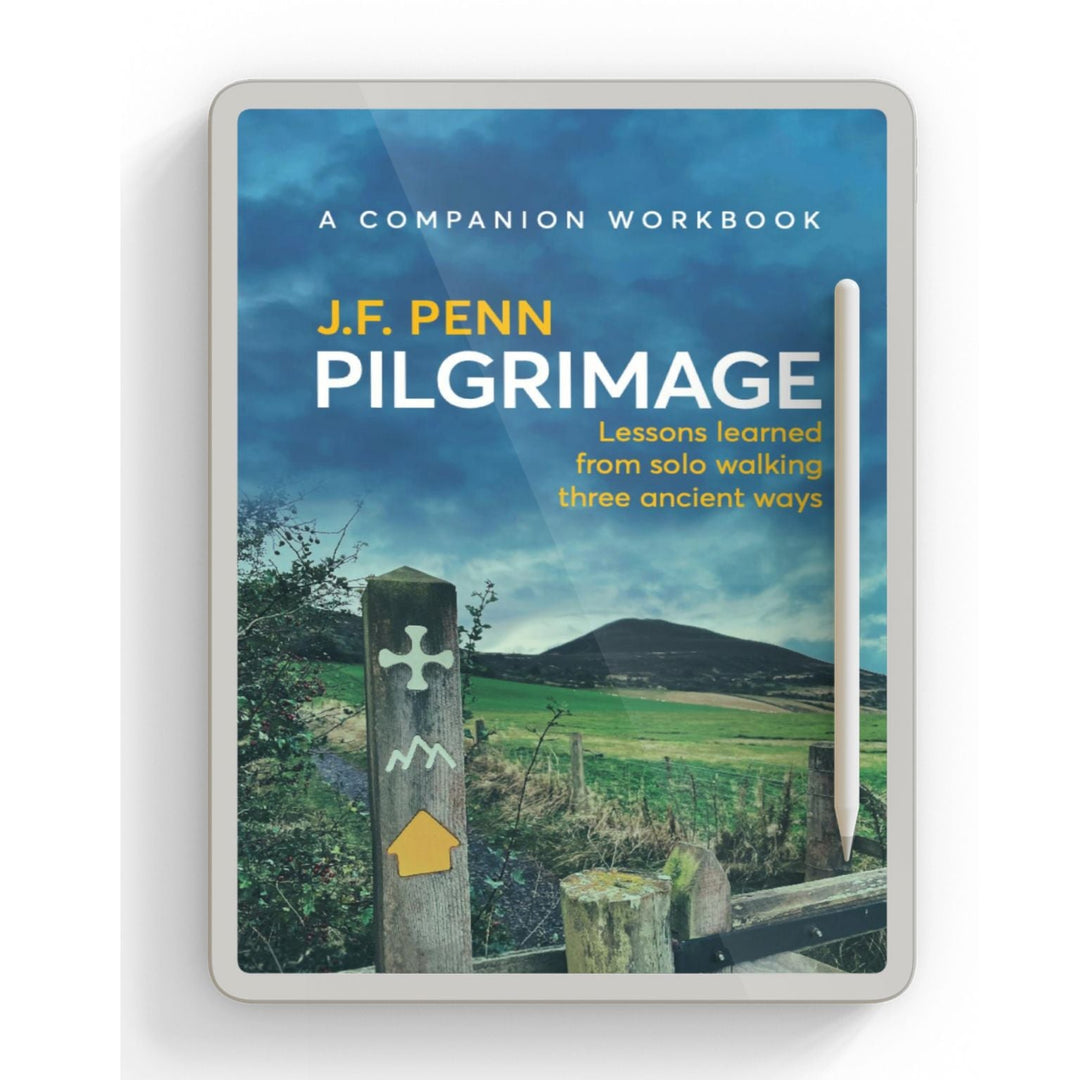


Pilgrimage: Walking in the path of history puts life in perspective
“Nothing ever is, everything is becoming… All things are passing and nothing abides.”
—Heraclitus
On each of my three pilgrimages, I encountered places where I was aware of walking through history, where there was a sense of life being but a brief flash of light across the span of time. My passing on each route was momentary, but pilgrims have walked the same ways for hundreds of years and will continue to walk for generations to come.
The three historic cathedrals are must-visit locations — Southwark Cathedral and Canterbury Cathedral on the Pilgrims’ Way, and the Cathedral of Santiago de Compostela at the end of the Camino. Each has their splendours, and it’s worth allowing extra time to visit them. In the same way, the ruined abbey of Lindisfarne and its associated church are insights into history — but these are all obvious highlights.
Here are some other places where I felt a historical perspective.
Mosaic mural on the Old Kent Road, London, England
The first day’s walk on the Pilgrims’ Way from Southwark Cathedral is through gritty, urban sprawl along a main road, dense with traffic. It might not look like much, but this is the Old Kent Road, originally built by the Romans, linking London to the coast near Dover, and later renamed Watling Street by the Anglo-Saxons.
At a busy corner with Peckham Park Road, under the overhanging porch of the Everlasting Arms Ministry, lies a gigantic thousand-square-foot mosaic mural. The History of Old Kent Road by Adam Kossowski has separate panels, each portraying an era of history. The foundation of the city by Romans in their togas surrounded by soldiers with military standards, then medieval London with Chaucer’s pilgrims heading for Canterbury and a quote from the poem. King Henry V rides in triumph along the road after the battle of Agincourt, followed by the rebellion of Jack Cade against the government. King Charles II reclaims the throne in the next panel, and then modern London emerges with its British ‘bobby’ policeman, Pearly Kings and Queens with their mother-of-pearl button suits, and the factories of the city with modern cars driving along.
The mural encapsulates two thousand years of history and yet most pass by without realising that the stones they drive over or walk along have witnessed such historical events.
The artist himself represents another aspect of modern history. Adam Kossowski was Polish and arrived in the UK as a refugee from the Soviet labour camps in 1943. As well as this mural, he created many other artistic works, including the History of the Carmelites of Aylesford, at the abbey, which also lies on the Pilgrims’ Way and where he was buried after his death in 1986.
You can find pictures at
www.jfpenn.com/oldkentroadmural
Lesnes Abbey, London, England
The ruins of twelfth-century Lesnes Abbey (pronounced ‘lane’) lie on the Pilgrims’ Way in an ancient woodland in east London. Founded in 1178 by the Chief Justiciar to Henry II, it may have been part of a penance to atone for the murder of Archbishop Thomas Becket.
After the Dissolution of the Monasteries in the sixteenth century, the abbey fell into ruin and was eventually lost to farmland before being restored in modern times. The ruins now feature much-appreciated public toilets and a cafe along the Green Chain Walk that forms part of the Pilgrims’ Way.
There is a memorial of three triple archways that overlook the ruins, and an ancient mulberry tree with the skyscrapers of the city of London framed on the horizon.
The mulberry tree represents patience, as it will not bud until there is no danger of frost. Its red berries also represent sacrifice, as depicted by Shakespeare’s forbidden lovers Pyramis and Thisbe, who died under a mulberry bush, their blood staining the berries red.
Lesnes Abbey is a place of ancient nature and medieval faith against a backdrop of modern London. Well worth a visit.
You can find pictures at
The cadaver tombs of Southwark and Canterbury Cathedrals, England
There are unusual cadaver tombs in both Southwark and Canterbury Cathedral, at the beginning and the end of the Pilgrims’ Way. These are rare depictions of the deceased as corpses as opposed to the grand effigies usually sitting above the tombs of nobility.
The Southwark cadaver is the medieval tomb of Thomas Cure, who died in 1588, the same year as the Spanish Armada, during the reign of Elizabeth I. Its skeletal frame is weathered by time, its face disintegrated. It’s clearly a dead body, partially wrapped in a shroud, a simple representation of the inevitability of death.
The Canterbury cadaver tomb is on an entirely different scale in terms of grandeur. The tomb of Archbishop Henry Chichele, who died in 1443, has two levels, one showing the effigy of the deceased man in full ecclesiastical robes and, underneath, the cadaver stripped of all its finery, lying naked except for a shroud. It’s surrounded by an ornately decorated arch with figures from church history. A tour guide told me that the archbishop had the tomb built many years before his death so he could look at it every day and contemplate his end.
You can see the pictures at:
www.jfpenn.com/canterburycadavertomb
www.jfpenn.com/southwarkcadavertomb
St Cuthbert’s Cave, Northumberland, England
This natural sandstone cave lies within a National Trust reserve on the final day’s walk towards Lindisfarne, Holy Island. The cave has a wide mouth and is ringed by a wood of Scots pine. According to legend, the monks fleeing from a medieval Viking invasion stopped in the cave with the remains of St Cuthbert.
It doesn’t really matter whether his body lay there or not over a thousand years ago. The cave is clearly a natural shelter from the dark and cold and wild weather, and humans certainly rested and slept here over millennia. There is fire damage and graffiti, both old and new, evidence of people making their mark across time.
On my approach to the cave, an adder with its distinctive zig-zag markings crossed the path in front of me. A protected species, the adder is the UK’s only venomous snake, but they are secretive creatures and rarely seen. I had never seen one in the wild before, and it was a precious moment.
As I sat on a rock in the rain eating my lunch, there was a sense of being part of an ancient environment. If I slept in the cave in the dark of night, perhaps I might hear the crackle of ancient flames and the whisper of the long-dead.
You can see a picture at
www.jfpenn.com/stcuthbertscave
Memento mori — Remember, you will die
While walking an ancient route like the Camino de Santiago helps the pilgrim to reflect on mortality, it is almost impossible to comprehend a thousand years of pilgrims walking ahead and many more coming behind.
But while I walked in September 2022, I had a vivid reminder of memento mori — remember, you will die — as Queen Elizabeth II died at the age of ninety-six on the second day of my pilgrimage. Snippets of her life punctuated each following day of my Camino on TV in coffee bars and glimpses of newspapers, and I couldn’t help but read some of the UK media coverage online when resting at the end of the day.
It was strange to walk outside of my country during such a historically significant week. I remember seeing newly carved statues of the Queen and Prince Philip mounted outside the cathedral in Canterbury on my first pilgrimage in October 2020. The stone was paler than the other sculptures of historic monarchs. The features weren’t yet weathered — and of course, both were still alive then. There was a sense of standing next to living history, as another generation passed, and now they are both gone.
I am not an ardent royalist by any means, but the Queen was a constant across my life, as she was for many people in the UK and around the world. As I walked my Camino, the news was full of pictures of her as a young woman, then middle-aged going through the trials of life, then an old woman at her husband’s funeral, and in her final days, standing bent over and smiling as she welcomed the new Prime Minister. The span of an extraordinary life against the backdrop of history.
Her life passed by, as will mine and yours. Even a Queen cannot hold back the end.
I walked into Santiago de Compostela on the day of her funeral and, as I rested in my hotel that afternoon, I watched her coffin being lowered into the vault at Windsor Castle. It was a fitting end to my pilgrimage and underscored the sense that something must die for change to happen — new life will emerge from the ashes of the old.
Questions:
• What aspects of history form part of your pilgrimage route?
• Which are you interested in visiting?
• Sometimes it is the unexpected places that mean the most. How can you keep an open mind so serendipity may alight at other times?
• How can ‘memento mori’ help you put life into perspective?
Resources:
• Pictures of The History of Old Kent Road mural by Adam Kossowski — www.jfpenn.com/oldkentroadmural
• Pictures of Lesnes Abbey — www.jfpenn.com/lesnesabbey
• Pictures of the cadaver tombs — www.jfpenn.com/canterburycadavertomb and www.jfpenn.com/southwarkcadavertomb
• Picture of St Cuthbert’s Cave — www.jfpenn.com/stcuthbertscave